Author: Takachika Hayashi | Translator: Katarina Woodman
Mountains are not merely landscapes to be viewed from afar. In Japan, mountains have long been regarded as places where kami and buddhas dwell, as well as places where people step away from everyday life and reexamine themselves. Shugendō developed as a religious culture in which practitioners enter the mountains, walk, pray, and discipline the mind through the body. It is generally understood as a uniquely Japanese system of syncretic religious practice, formed through the layering of ancient mountain worship with Buddhism, Shinto, esoteric Buddhism, Daoism, and Onmyōdō (Miyake, 2001; Sekimori, 2009).
Practitioners of Shugendō are known as yamabushi, shugenja, or gyōja. For them, mountains are not simply physical locations for ascetic training. Steep paths, rocks, cliffs, waterfalls, and trees form the environment, while mist, rain, and wind further shape the experience. All of these are manifestations of the sacred, and walking through the mountains itself was both prayer and practice. In the official explanation provided by Sakuramotobō, a temple located on Mount Yoshino, one of Shugendō’s sacred sites, Shugendō is described as “the path of practical training and direct experience,” a path in which practitioners enter the mountains, purify their own souls, and use the virtue gained through practice for the benefit of others (Sakuramotobō Official Website).
At the center of this tradition is En no Gyōja, also known as En no Ozunu. En no Gyōja is described as the founder of Shugendō and is deeply connected to mountain sacred sites such as Mount Ōmine in Nara Prefecture, Kinpusen in Yoshino, Nara Prefecture, and Yoshino itself. Yoshino and Ōmine, in particular, are indispensable places for understanding Shugendō. The route that runs from Mount Yoshino through the Ōmine mountain range and onward to Kumano is known as the Ōmine Okugakemichi. It has long been regarded as an important path of ascetic practice, along which Shugendō practitioners traverse the mountains while praying (Yoshinoyama Tourism Association; Cultural Heritage Online).
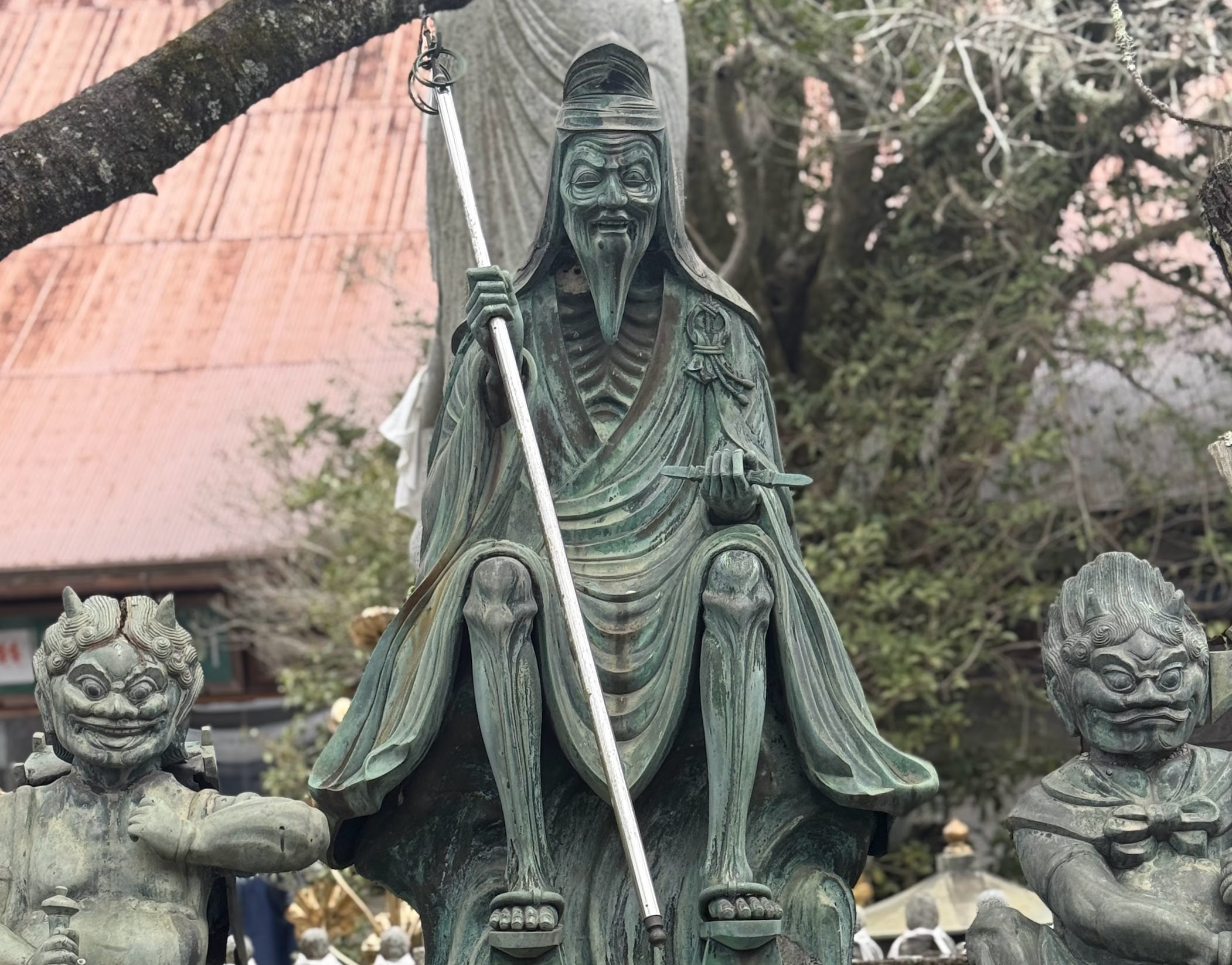
※Statue of En no Gyoja at Sakuramoto-bo Temple
Mount Yoshino
When people think of Mount Yoshino, cherry blossoms may be the first thing that comes to mind. However, the cherry blossoms of Yoshino are not simply famous blossoms at a scenic spot. Mount Yoshino refers to the ridge area extending from the northern end of the Ōmine mountain range, and it also has a long history as a sacred site of Shugendō. In the UNESCO World Heritage Site “Sacred Sites and Pilgrimage Routes in the Kii Mountain Range,” Yoshino and Ōmine, the Kumano Sanzan, and Mount Kōya are connected by pilgrimage routes and are recognized as a cultural landscape shaped by the fusion of Shinto nature worship and Buddhism (UNESCO World Heritage Centre).
Academically as well, the mountains of Yoshino, Ōmine, and Kumano have been understood not merely as geographical spaces, but as a “sacred geography” that reflects the world of kami and buddhas in this world. Grapard (1982) points out that the Yoshino and Kinpusen side was likened to the Diamond Realm Mandala, while the Kumano side was likened to the Womb Realm Mandala, with Mount Ōmine understood as the center connecting the two. In other words, in Shugendō, walking through the mountains is a bodily journey through the world of kami and buddhas.
Sakuramotobō, located on Mount Yoshino, is one of the important temples that preserves Shugendō to the present day. According to its official website, Sakuramotobō is a training hall of shinbutsu shūgō, the syncretic blending of kami and buddhas. Temple tradition holds that its origins lie in an event in the tenth year of Emperor Tenji’s reign, when Prince Ōama, who was practicing asceticism in Yoshino, dreamed of cherry blossoms in full bloom on the winter mountain. It is said that the dream was interpreted by Kakujō, a senior disciple of En no Gyōja (Sakuramotobō Official Website).
The appeal of Sakuramotobō lies in the way the beauty of Yoshino’s cherry blossoms overlaps with the history of Shugendō prayer. Within the temple grounds, traditions connected to the worship of En no Gyōja are preserved, along with Buddhist statues designated as Important Cultural Properties. The temple is also positioned as a base for ascetic practice along the Ōmine Okugakemichi. For this reason, walking through Mount Yoshino is not simply a visit to a famous cherry blossom site. It is also a journey that traces the history of mountain worship behind the flowers and offers a small experience of Shugendō as a “religion of entering the mountains.”
Next time, drawing on my actual visit to Mount Yoshino and my walk through Sakuramotobō, I would like to consider how this place can be both a “tourist destination” and a “site of ascetic practice.”