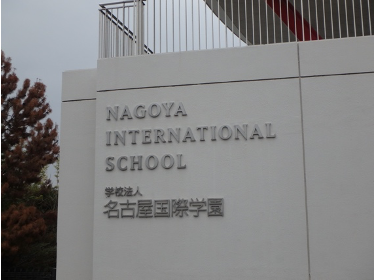
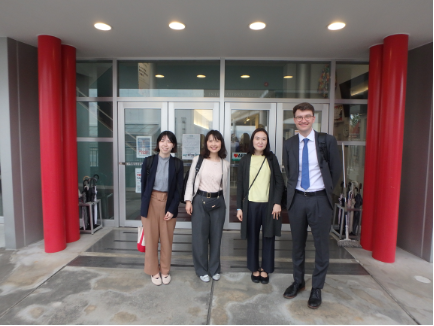
On Thursday, March 27, 2025, four members of the Multicultural Education Team, including Dr. Joonha Park, Dr. Thomas Brotherhood, Ms. Akane Tano, and Dr. Yoshimi Okumura, visited Nagoya International School (NIS). Founded in 1964, NIS is an international school that welcomes students from diverse cultural backgrounds and is now an IB World School, an IB-accredited institution. During the visit, the group had the opportunity to interview both Head of School Matthew Parr and Elementary Principal Travis Peterson, tour the campus, and observe classroom instruction.
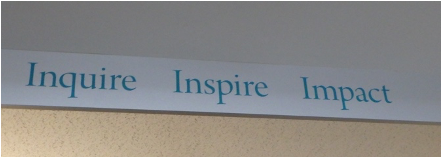
At NIS, the guiding principles are “Inspire, Inquire, Impact” and “Inclusiveness.” Although instruction is conducted in English, the students’ first languages are varied, and the use of languages other than English is permitted. However, the school emphasizes not only language use but also the social impact of one’s actions. A key rule is that when students use a non-English language, they must ensure it does not exclude others who cannot understand that language. Walking through the campus, one could hear languages such as Japanese being spoken. The library, located at the heart of the school, held books in many languages, and even the restroom signs were displayed in multiple languages. The week following the visit was designated as International Week, during which students were scheduled to wear traditional clothing and participate in activities that celebrate and explore different cultures.
In academic subjects, inquiry-based learning is emphasized in accordance with the IB program. During the visit, the team observed part of a Middle Years Programme (MYP) language arts class. The students had just finished a unit on Shakespeare’s plays and were reflecting on their learning using their devices. They wrote about three points: (1) their understanding of the play they read, (2) which class activities helped them understand it, and (3) which activities were less helpful. It was clear that the lessons had focused on conceptual understanding. The students’ reflections also seemed to provide teachers with an opportunity to review their own teaching practices. After completing their reflections, students shared the skills and understandings they had developed through the Shakespeare unit, followed by an introduction to the new unit. The next unit focused on Maus by Art Spiegelman. Students were each given a copy of the book and asked to record their thoughts on what kind of story it might be based on the cover. After sharing their ideas with the class, they watched an interview video in which Spiegelman discussed the background of writing Maus, helping them deepen their understanding of the text.
The lesson emphasized enabling students to develop their own perspectives and read inquisitively, while becoming aware of how their understanding deepened through the process. Although the IB program may not have been designed specifically for multicultural education, it values creating opportunities for students to learn through inquiry and share their learning with others, enabling each learner to study in their own way and learn collaboratively. This approach is also of great importance in multicultural education. The perspectives learned at NIS are likely to serve as valuable insights for fostering inclusion of diverse students not only in international schools but also in many schools throughout Japan. We want to take this opportunity to express our heartfelt gratitude to the faculty and staff of NIS for providing us with this valuable experience.

Text by Yoshimi Okumura
(Translated by Katarina Woodman)