On March 14, 2026, Lecturer Joonha Park gave a research presentation at the FY2025 Collaborative Research Project Results Report Meeting hosted by the Kyoto University Institute for the Future of Human Society. This report meeting was held with the aim of fostering active discussion among researchers and promoting interdisciplinary collaborative research within the university. This year, multiple researchers presented under four themes: “Communicating Non-Western Thought and Values to Society,” “Well-Being Related to Human Life and Livelihood,” “Integration of the Arts and Sciences in Art and Culture, Social Collaboration, and Outreach,” and “Measurement, Analysis, and Implementation of Social Infrastructure, Social Systems, and Policy Functions.”
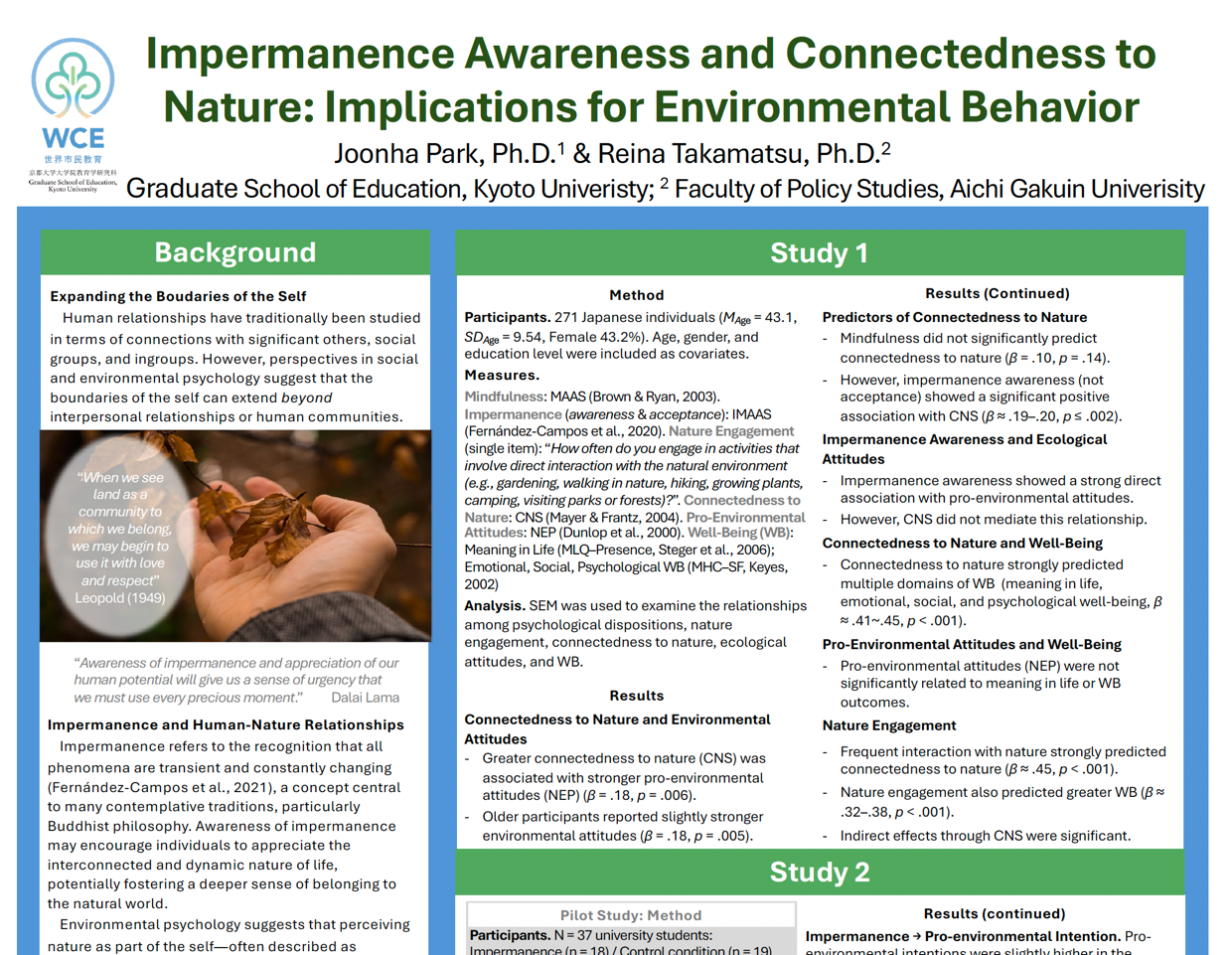
The title of the presentation was “Impermanence Awareness and Connectedness to Nature: Implications for Environmental Behavior.” It proposed that awareness of mujō (impermanence or nothingness) may enhance people’s sense of connectedness to nature, and through this, promote environmentally conscious attitudes and behaviors.
Mujō is a characteristic shared by both human life and the natural world, and for that reason it may foster a broader sense of connection that transcends national, social, and human–nature boundaries. This study employed both correlational and experimental methods. The results showed that emotional connectedness to nature strongly predicted environmentally conscious attitudes as well as multiple dimensions of well-being, demonstrating that it plays a central role in the relationship between humans and nature. Furthermore, the findings suggested that awareness of impermanence may influence environmental behavior through the mediating effect of connectedness to nature. These findings have important implications for environmental education, suggesting that incorporating awareness of impermanence into education may strengthen connectedness to nature and encourage environmentally conscious attitudes and behaviors.