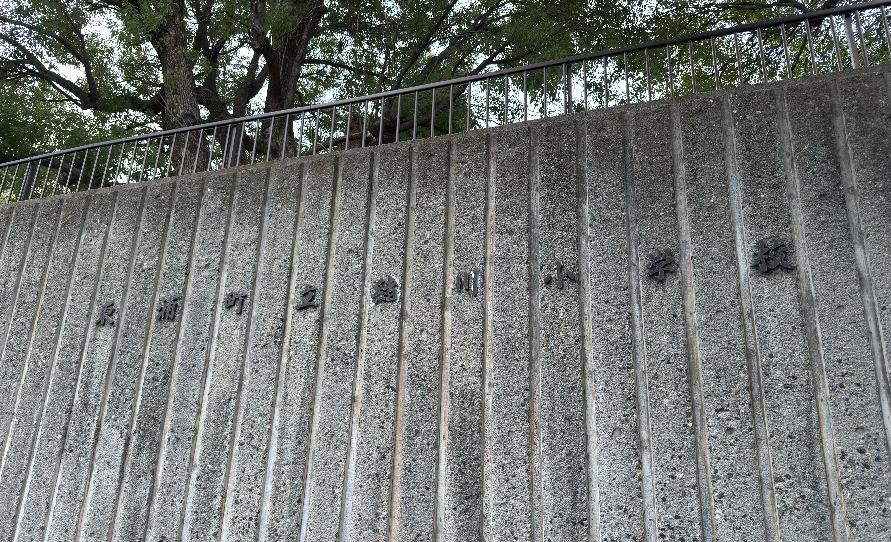
On Friday, October 10, 2025, Akane Tano (2nd-year doctoral student) from the Multicultural Education Team took part in the “FY2025 First School Site Visit” at Ogawa Elementary School in Higashiura Town, Aichi Prefecture. Ogawa Elementary School established its own curriculum following a 1978 campus renovation and is known as a pioneering experimental school for individualized and personalized education. The school has also been a member of the UNESCO Associated Schools Network (ASPnet) since 2011 and promotes ESD (Education for Sustainable Development). During the visit, we received an overview of the school, observed lessons, and had the opportunity to hear from the school’s research coordinator.
Since it began working on individualized and personalized education roughly 50 years ago, Ogawa Elementary School has placed the utmost importance on respecting each child’s aptitudes and individual differences, advancing a model that combines individualization of instruction with personalization of learning. Rather than focusing on the content of specific subjects such as Japanese, mathematics, or science, the school re-examined the entirety of learning activities from the perspective of “the child’s mode of learning,” and advanced its approach by organizing original programs such as those shown in the table below.
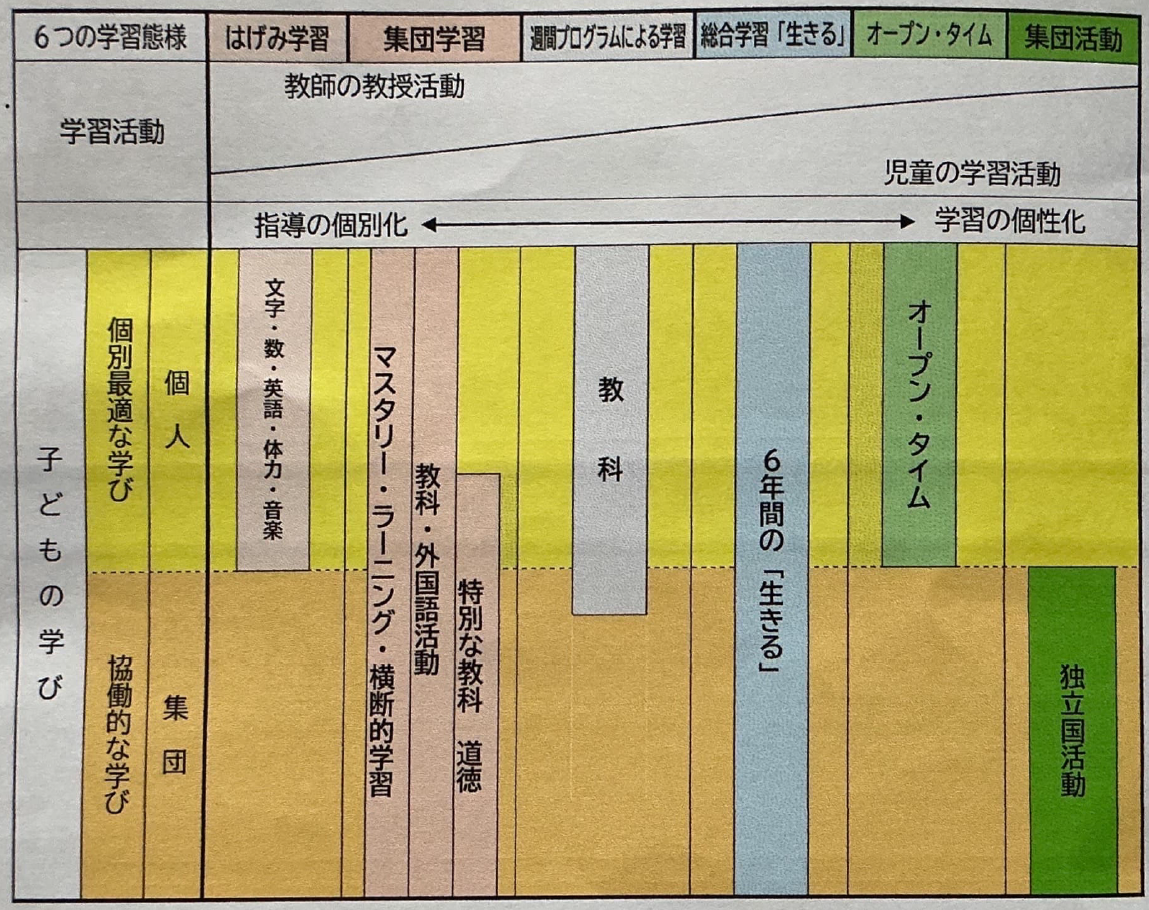
(Six learning programs, from materials provided by Ogawa Elementary School)
The “Learning under the Weekly Program” we observed belongs to the domain of subject-based study, yet it emphasizes individualized learning activities. In this program, self-paced learning proceeds across multiple subjects simultaneously. Each year, several units are selected that have clearly defined content and lend themselves to self-checking, and that are also highly cross-curricular; students can then study multiple subjects (units) in parallel at their own pace.
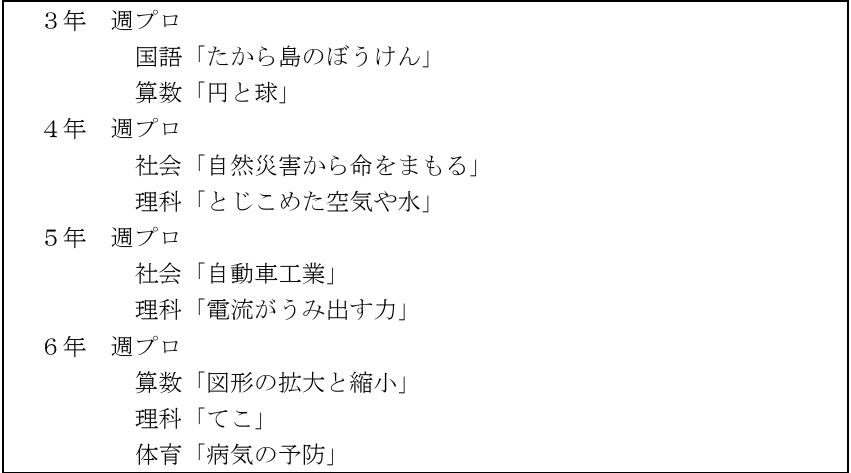
(Units being studied during the visit, from materials provided by Ogawa Elementary School)
With reference to a “Study Guide” (a compilation of learning goals, standard hours, learning flow, reference materials, etc.) and teachers’ advice, students devised their own study plans and pursued individualized study accordingly. Some children worked quietly on experiments to investigate electric current strength on their own, while others brought together notes on the characteristics of regions within Aichi Prefecture and engaged in discussion about where an automobile factory should be built.
In these lessons, the emphasis appeared to be on enabling children to think for themselves and to learn while also experimenting with their own “ways of proceeding,” thereby fostering motivation for learning and helping them become aware of their own interests, curiosities, and strengths. While individualized and personalized education at Ogawa Elementary School may not be intended specifically as multicultural education, it offers many suggestive practices that speak to the premises of multicultural education and valuing each individual’s uniqueness and realizing collaborative learning on that basis. We would like to take this opportunity to express our gratitude to the teachers at Ogawa Elementary School and to members of the local community for taking time out of their busy schedules to provide this valuable opportunity.