Author: Katarina Woodman
This comedy sketch has been in the group chats of foreign residents in Japan for awhile now, with the usual mix of reactions.
“lol, too real, I hate how accurate this is. This happened to me last week.”
The setup is ordinary enough to feel harmless. There is a restaurant and a table of customers who are, in the broadest sense, “foreign.” However, the waitress approaches the table and immediately begins speaking to the Asian foreigner present in Japanese. But here we learn that it’s actually the non-Asian foreigners at the table who are born and raised in Japan. They explain that the Asian foreigner was an American and doesn’t actually speak any Japanese at all. Despite this, the Japanese waitress acts as if she cannot understand English and focuses exclusively on the Asian foreigner.
It’s funny because the contradiction is exaggerated to the point of absurdity. In the sketch, the waitress’s confusion keeps escalating even as the situation becomes more obvious. The experience isn’t necessarily harmful in and of itself, and so it is easy to satirise the experience that feels familiar to any visibly foreign individual who has lived long enough in Japan.
But while minor misidentifications like the waitress makes in a restaurant may be harmless in most cases, they stem from a reflex that leads to deeper prejudices.
What is going on here?
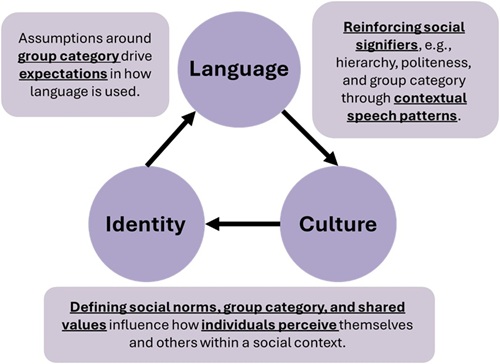
In this video, things like visual social identity cues are part of the predictive context that listeners uses to process speech. Thus, expectations about a speaker is shaping what listeners think they hear, even when the linguistic signal remains constant.
This assumption is built on, in part, the Japanese/foreigner dichotomy that is so prevasive in the cultural perspective where social categories often function as moving targets made up of markers, or signals, that people use to decide who belongs. In research on “social markers of acceptance,” these markers are described as socially constructed criteria (like language proficiency, adherence to norms, or genealogy) that people use when deciding whether to treat someone as part of the national ingroup(Komisarof et al., 2019; Komisarof et al., 2025).
These markers are not fixed. They tend to become stricter when people perceive “threat,” and they can shift depending on who is being judged, sometimes emphasising sociolinguistic and ethnic conformity and sometimes socioeconomic “usefulness.”
Empirical work with Japanese youth suggests that “being Japanese” is often inferred from everyday cues, such as Japanese-language use, phenotype, name, behaviour, nationality, and other markers of belonging. This means that a single marker can outweigh the others, leading to exclusion from an identity even when the individual meets the criteria in all other respects (Sato, 2021). In this context, even citizens can be treated as outsiders if the “wrong” ancestry is assumed and groups with deep historical ties can be positioned as perpetual non-members unless the boundary conditions are met (Sato, 2021; Komisarof et al., 2025).
This is not only about individual prejudice. It’s also about how “Japaneseness” has been socially constructed as a bundle of language, culture, race, and nationality pressed together, so that “not Japanese” becomes a catch-all category for different (Yamashiro, 2013). Once that bundle is treated as obvious, the question “Who is Japanese?” stops being descriptive and starts being prescriptive and can subsequently effect how members of the society allocate trust, patience, and social recognition.
In everyday interactions, that extra processing demand can show up as a conversational hiccup such as delayed responses, abrupt simplification, unnecessary switches to English, or visible surprise that interrupts the flow of conversation. In the sketch we saw earlier, the waitress keeps circling back to is not actual language ability, but a shortcut category of Japanese versus foreigner.
Building on this commonly joked about experience, my ongoing research has looked into this phenomenon in an empirical design. In my recent research, I address how Japanese listeners process the same Japanese differently depending on the visible appearances of the speaker. In this, I look at surprisal response as the mechanism beneath this language phenomenon, particularly being an observable increase in processing cost when an event is less expected given the listener’s current predictive context.
Crucially, this context includes social identity cues like a speaker’s appearance, not just the preceding words. In other words, if a listener has learned an implicit mapping like “foreign-looking → English / non-fluent Japanese,” then fluent Japanese from a speakers percieved as foreign can function as a low-probability event, meaning that it takes more effort to understand what is being said regardless of how fluently the individual is speaking.
Current results have shown indications that processing-demand differed when Japanese participants viewed speakers who appeared foreign compared to speakers who appeared Japanese. In particular, surprisal scores increased and performance on the memory-task decreased significantly when the participants were viewing foreign-appearing speakers compared to Japanese-appearing speakers, even when the voices themselves were the same.
In a follow-up studies, it was also found that group-affiliation further affected the phenomenon as performance was significantly altered when the foreigner was indicated to be from Japan versus from abroad. Ethnic ambiguity also effected the phenomenon by slowing down response times when the identity of the speaker was unclear and reducing performance compared to the Japanese-appearing speakers.
In a third study, it was found that percieved accent was significantly higher when the speaker appeared South Asian or white compared to when they appeared Japanese or East Asian, leading to a higher bias towards South Asian or white speakers speaking English and Japanese or East Asian speakers speaking Japanese.
One useful way to describe this psychologically is that people are constantly predicting what they are about to encounter, then adjusting based on what they actually see and hear. Essentially, we do not take in the world like a camera, but interpret it using expectations built from past experience. When what we expect matches what happens, conversation feels smooth. When it doesn’t, we feel a mental “jolt,” or a moment of confusion and effort while the brain tries to resolve the mismatch. In social situations, expectations about groups can become part of that prediction system, so the listener’s first impression can shape what they notice, how they interpret the same words, and how they respond, sometimes before they are even aware they are doing it. That is why bias is not only about consciously held opinions, but can also operate as an automatic default that guides attention and interpretation unless something forces it to update.
How does this matter?
Of course, relying on visual cues is a normal part of how we move through everyday life. In most contexts, visible markers do give us quick, useful information such as who might need directions, what language a sign might be in, what kind of interaction this is likely to be. So a waitress misunderstanding someone at first, or a student blinking in surprise when a “foreign-looking” classmates speaks fluent Japanese, is just an ordinary glitch in social perception. The problem begins when that split-second inference stops being a tentative guess and starts affecting the interaction. At that point, the category shifts from descriptive (“this is what I think is happening”) to prescriptive (“this is what must be happening”), and the interaction gets organized around the assumption rather than the person in front of you.
However, the consequences can have substantial implications on people who make up Japanese society. Outgrouping shows up as repeated micro-decisions that shape daily life and long-term outcomes, such as being treated as less competent within the workplace, being excluded from “normal” interactions within the community, facing barriers and extra scrutiny in institutions, and carrying chronic stress from never knowing when the category will override the person. It also undermines the conditions for building trust and peaceful communities as communication and cooperation get filtered through suspicion and distance rather than ordinary reciprocity (Rogers et al., 2020).
And in turn, this can have critical implications on those who end up falling into the out-group. For example, in individuals like Zainichi Koreans who, despite having lived in Japan for multiple generations, can often face prejudices within their daily life leading to both socioeconomic and psychological negative impacts, as reported in quotes such as:
“When I was in elementary and junior high school, I was so distressed, I wanted to disappear. That’s how painful discrimination can be for a human being.”
「俺は小学生、中学生の時に自殺したいぐらい悩んだんだ。本気で自殺しようかと思ったぐらい悩んだ。それぐらい差別、人間に対する差別というのは、つらいものがあるのよ。」
— Masayoshi Son, founder/CEO of SoftBank Group
Struggles with discrimination are not unique to any particular culture, but there’s a particular kind of pain in being present and still not being seen. When those percieved as foreign regularly treated as an outsider, daily life can start to feel like a series of small tests where choosing the “right” words, gauging whether your accent will be judged, deciding when to speak and when to stay quiet, bracing for the moment someone switches to simplified language or dismisses what you just said, and so on can all build up to shrink their world and leave them with fewer places to move through life without friction.
In the Japanese context, the dominant public language for diversity, tabunka kyōsei (多文化共生ーmulticultural coexistence), often emphasises cultural understanding and communication, but has long been criticised for what it leaves out. One critique is that focusing on “culture” can make economic and social inequality harder to see and can even reproduce an “us/them” split. This causes recognition to stay at the level of surface decorations (food, clothing, festivals) while deeper equality remains untouched (Nagayoshi, 2018).
In other words, that promotion of “coexistence” continues to run on rigid membership categories in everyday life.
How does this relate to world citizenship?
This is where world citizenship becomes more than a mere slogan. If we are to change our perspective on “world” so that it can hold a wider, dynamic whole, the task is to learn how to stay open to that whole without erasing what makes us who we are in the process.
Crucially, the educational move is to shift from being trained mainly to “answer” toward being trained to “question.” Categories are unavoidable tools for navigating uncertainty, but in predictive processing terms, they function as priors or initial predictions about what is going on before the full evidence is sampled (McGovern & Otten, 2024). Thus, categories become a problem only when they stop being a quick first guess and start acting like the final answer.
For example, in the waitress scene, it’s normal that she uses appearance to make an initial assumption. Everyone does that in daily life. The issue is that she continues to treats that assumption as certain. Even when the conversation gives clear evidence, the foreign individuals clearly not actually being foreigners, the interaction stays locked onto the original label. That is the point where a category shifts from a helpful shortcut (“maybe this is what’s going on”) into a prescriptive rule (“this must be what’s going on”), and it starts shaping how much patience, attention, and credibility someone is given.
World citizenship education matters here because it targets precisely the point where priors become too certain. If learners are supported in (1) noticing what they are assuming, (2) treating assumptions as hypotheses rather than verdicts, and (3) repeatedly encountering counter-stereotypical, ordinary examples in contexts where those examples are socially recognised, then priors can become less rigid and more responsive to evidence. This is shifting to a position where we are belief updating, leaning into experience-dependent learning to revise what is expected next time. In other words, the intervention target is to help lower the precision of membership-policing priors and increase willingness to update them through contact, reflection, and practice.
This also clarifies why “Japanese-style multicultural coexistence” can fall short when it becomes depoliticised and dehistoricised. It may talk about difference while leaving the underlying predictive defaults untouched so that it is still organised around who counts as a “normal” participant in Japanese-speaking space.
By contrast, taking world citizenship seriously means rebuilding interaction on something other than membership policing, meaning a need to shift towards attention to context, shared practices, and relationship, alongside deliberate training in metacognitive awareness of one’s own predictive shortcuts.
References
Komisarof, A., Leong, C.-H., & Lim, T. (2025). Social markers of acceptance in Japan: Examining acceptance criteria for immigrants of different ethnocultural heritages. International Journal of Social Psychology / Revista de Psicología Social, 40(2–3), 508–558. https://doi.org/10.1177/02134748251337713
Komisarof, A., Leong, C.-H., & Teng, E. (2020). Constructing who can be Japanese: A study of social markers of acceptance in Japan. Asian Journal of Social Psychology, 23(2), 238–250. https://doi.org/10.1111/ajsp.12396
Kurimoto, H. (2016). Nihonteki tabunka kyōsei no genkai to kanōsei [Limitations and possibilities of Japanese-style multicultural coexistence]. Mirai kyōseigaku, 3, 69–88. https://doi.org/10.18910/56236
McGovern, H. & Otten, M. (2024). Priors and prejudice: hierarchical predictive processing in intergroup perception. Frontiers in Psychology. https://doi.org/10.3389/fpsyg.2024.1386370
Nagayoshi, K. (2018). Nihonjin no tabunka shakai ni taisuru ishiki [Japanese attitudes toward multicultural society]. Tōhoku bunka kenkyūshitsu kiyō, 59, 35–47. http://hdl.handle.net/10097/00127840
Rogers, L., Ottman, E., & Pavloska, S. (2020). Hidden biases and their influences on multiple oppressions experienced by non-Japanese residents in Japan. 現代社会フォーラム, 16, 14–33. https://dwcla.repo.nii.ac.jp/record/1947/files/AA1201534X-20201005-14.pdf
Sato, Y. (2021). ‘Others’ among ‘Us’: Exploring racial misidentification of Japanese youth. Japanese Studies, 41(3), 303–321. https://doi.org/10.1080/10371397.2021.1982645
Yamashiro, J. H. (2013). The social construction of race and minorities in Japan. Sociology Compass, 7(2), 147–161. https://doi.org/10.1111/soc4.12027